We are tired of corruption, big money influencing our laws, and stupid political discourse. The system is broken. It needs a major upgrade.
We believe that democracy must be honest, productive, and corruption-free.
Let's upgrade the way our laws are created. Here's how:
We believe that all citizens should be able to propose initiatives, thoughtfully discuss matters, and co-create laws. We believe that laws should be made with transparency and not behind closed doors. The actions and votes of representatives should be visible to others.
We believe citizens should always have the choice of voting directly for laws or delegating their vote to others. Citizens should be able to select the representatives they want at any time and change them immediately when they feel they no longer represent them.
We believe that becoming a representative shouldn't mean selling your soul to the political machine. It should be easy for any citizen to be able to represent others. A few or many.
All of us, together, can have a massive impact on the laws that affect us.
Become part of your own local revolution. The plan of action is simple, yet ambitious:
- Launch or support a campaign to get enough seats in your local legislative body
- Once elected, supersede the legislative body with a technology platform where initiatives can be proposed, ideas can be thoughtfully and publicly debated, votes can be cast privately, representatives can be picked and scrutinized, and decisions can be made with transparency
Neocratia's vision may appear utopic to many, but so too were the ideas of true democracy and universal human rights. Together, we can make Neocratia a reality. It won't be perfect and it won't be easy, but we must start somewhere. We must iterate, improve, and move things forward. All you have to do is click here to send us your email address. As soon as enough people in your area are interested, we'll help you lead or become a member of your own local movement. Please remember that if you do nothing, you are actually perpetuating the problem — the choice is yours.
The origins of Neocratia
Neocratia started when a bunch of us got together and asked ourselves:
"If democracy were invented today, what would it be like?"
We sought the advice of thought leaders in several sectors. We invested time in researching the origins of democracy itself and were particularly inspired by the French political philosopher, Alexis de Tocqueville (1805–1859).
In 1835, Tocqueville travelled to the youngest democracy in the world and collated his conclusions in a book called Democracy in America. Tocqueville believed that democracy has a tendency to degenerate into 'soft despotism', where a country is overrun by "a network of small complicated rules" that degrade the democratic processes. Thus, while people are under the illusion that they are in control, they can actually exercise very little influence over their government.
Tocqueville predicted that the American democracy was constructed in such a way that it would inevitably spiral into a society awash with individualists who would do little more than contribute to a burgeoning bureaucracy. People would surrender their common and communal responsibility to government, forgetting their own interests. A society would remain that was dominated by individualism in which bureaucracy ruled and the government was both aloof and distant.
Sound familiar, right? We firmly believe that Tocqueville described what is happening all over the world. Our politicians are disconnected, bureaucracy rules, and citizens have lost their connection to the origins of democracy.
We conducted hundreds of brainstorm sessions on the topic. While we found many aspects and instances where democracy would be similar to what it is today, we also found many others where it would be both very different — and better. One of them, in particular, could have a major impact on the way democracies work: the process of creating laws.
Simultaneously, we started coding nights and weekends developing the software required to prototype some of the best ideas.
After two years of researching and experimenting, we identified the most promising ideas and combined them in this manifesto:
We call it Neocratia and our mission is to upgrade the way our laws are created and societies govern themselves.
We at Neocratia are activists who remain committed to improving democracy. Like casting a pebble into a pond, we believe that in time, the ripple we start will reach the furthest shore.
Today more than ever, ordinary citizens need to get involved; they need to stand up and be counted; they need to rally for change in the mechanics of government.
Neocratia can succeed in many ways: it can enable the creation and improvement of thousands of democracies, big and small, become the legislative branch of existing democracies, make democracy part of our daily lives, enable introverts to become political leaders, and more. We expect, at least, to inspire others to improve the government of the people, by the people, for the people.
The proposal process
In a Neocratic community, all people eligible to vote for proposed initiatives will be able to do so.
- Initiatives are submitted using an electronic platform;
- They are publicly debated by the community;
- Should a significant number of citizens show interest in a particular initiative, the drawing up of a draft law is initiated;
- The citizen who initially proposed the initiative may invite others to help draft the law proposal. An online collaboration tool is used (similar to Google Docs, Wikipedia, or Git). Citizens may also discuss the draft as a whole or different parts of it. A log of changes is kept;
- When the citizen who initially proposed the initiative decides the drafting process is complete, the law proposal is scheduled for voting.
Debating initiatives or ideas
Within a Neocratic community:
- All people eligible to vote in any given jurisdiction may participate.
- Conversations happen online via an electronic platform.
- Conversations could be centered about a proposal or any other topic relevant to the group.
- Citizens are able to upvote or downvote the comments of others.
- Comments that people agree with the most become more visible by rising to the top of threads, thus reducing bubble effects.
- Conversations and comments are transparent. Upvotes and downvotes by representatives are public; those by individual citizens are private.
Making decisions
Neocratic communities make decisions by voting on law proposals. These can be new or replace existing laws. Voting happens online via an electronic platform. Law proposals are publicly scheduled for voting. Voting lasts for a few days, and the results are then made public.
We believe citizens should be able to vote for laws directly or delegate their votes to others. Each citizen eligible to vote within a jurisdiction has three voting options.
- The citizen can do nothing. If the citizen has chosen one or more representatives, the representatives vote on behalf of the citizen. If the citizen does not have a representative, or their representative(s) do not vote, they will abstain from the vote.
- The citizen may choose one or more one-time representatives to vote on their behalf. If the citizen had chosen one or more representatives who had already voted for the law proposal, the vote of the one-time representatives will override the decision of the general representatives. Citizens may change representatives up until voting closes.
- The citizen can vote directly for the proposal, thereby overriding the decision made by the representatives on their behalf.
Each citizen is given control by being able to view how their chosen representatives, and the representatives of their representatives, voted for a law proposal while the voting is still in progress. To avoid groupthink, the overall voting results are only made public when the voting ends.
Some call this type of decision-making liquid democracy.
Choosing representatives
Citizens eligible to vote within any Neocratic jurisdiction may choose representatives using an electronic platform. When citizens don't vote for a law proposal directly, representatives vote on their behalf. Representatives, in turn, can delegate their vote, and those delegated to them, to other representatives. When choosing two or more representatives, the vote delegation will be split into equal parts. Thus, if a citizen chooses four representatives, each representative will be able to vote (or delegate) 25% of the citizen's vote.
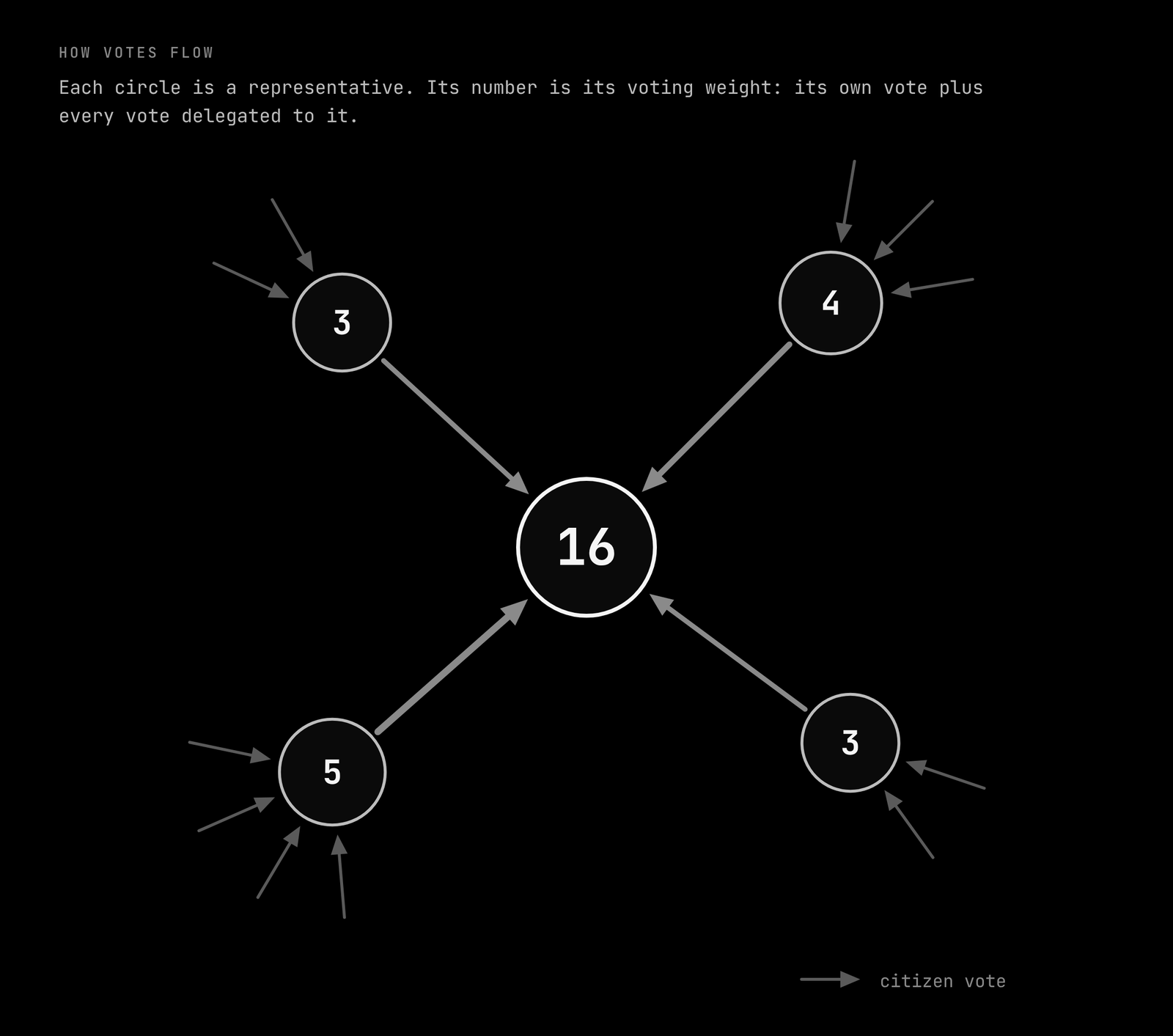
Representatives have a voting weight. This is the sum of all votes delegated to a representative plus the representative's own vote. Representatives may also choose their own representatives and delegate all their voting weight.
In a Neocratic community, all citizens may allow others to choose them as representatives. The only requirements are their agreeing to making all votes transparent and visible to others and volunteering their work. Similarly to how volunteers have created Wikipedia and made it broader, fairer, and more accurate than previous encyclopedias created by paid editors, we believe that many volunteer representatives will perform a better job than a few paid, income-dependent politicians.
Neocratia citizens are able to choose the representatives they want at any time and change them should they no longer feel duly represented.
Scrutinizing representatives
Representatives in Neocratic communities have public profiles on an electronic platform. This allows citizens to determine how their representatives voted for law proposals, which comments were upvoted and downvoted by their representatives during debates, whether the representatives chose their own representatives, as well as their voting weights.
Neocratia and its electronic platform
Neocratia's values and principles require a reliable and secure electronic platform.
We are currently building an open source platform called Neocratium, and we encourage others to build alternatives. (We'll gladly advise.) Neocratium will allow communities of any size and type — even non-political ones — to manage their democracies. Once Neocratium is ready, groups can create communities using the hosted version, or download the source code and install their own on a server.
When a community uses Neocratium, the settings of the platform will be managed by a team of administrators. The platform administrators will be appointed by the executive branch of the government of each community (following procedures similar to current democratic convention). Each citizen will have an account provided and/or approved by the administrators. Neocratic communities must provide their citizens with the means to access the electronic platform, including devices and connectivity. Neocratium will offer single sign-on integration with existing electronic IDs already offered by numerous governments.
Neocratia will be working with electoral management bodies (EMBs) and other NGOs to guarantee that Neocratium and the other electronic platforms work towards preventing, recording, and reporting potential electoral fraud.
If you are interested in helping to create Neocratium as a volunteer, please contact neocratium@neocratia.org.
If you are considering building or adapting a platform based on the values and principles of Neocratia, we can help. Contact build@neocratia.org.
Our plan of action
In summary:
- We aim to identify several communities around the world that are ripe for launching a successful campaign to get enough seats in their local legislative body;
- Once elected, they upgrade the legislative body with a technology platform (Neocratium or an alternative one) where initiatives are proposed, initiatives debated, and votes cast privately. Representatives are constantly scrutinized, and decisions made with transparency;
- Once Neocratia has been shown to work in a few communities, we aim to make as many communities as we can around the world Neocratic.
The roadmap for each community:
- Members of a community pledge to elect Neocratia representatives in their traditional elections;
- If required, the local movement completes the paperwork to elect representatives to public office — such as registering a political party, collecting signatures, etc.;
- Should enough pledges be made, the pledgers vote for Neocratia candidates when elections take place;
- Once elected, Neocratia representatives pass the laws needed to upgrade the legislative body with a technology platform (Neocratium or an alternative one).
Should an insufficient number of Neocratia representatives be elected to pass the legislation required to upgrade the legislative body, those representatives will act as proxies until the following election cycle.
Proxy representatives act as intermediaries between the group who elected them and the public office they are elected to. Their actions are circumscribed by the decisions of the group using Neocratium.
Proxy representatives won't have an opinion of their own. They will be accountable as their reputation will be on the line. If a proxy representative fails at their job, and depending on the government's legislation, the group that elected him/her may be able to impeach them.
Would you like to know more? Click here and send us your email address. As soon as enough people in your area are interested, we'll help you lead or become a member of your own local movement.
Neocratia funding
Neocratia is a non-profit effort that depends on donations from people like you. We're tired of big money and corporations influencing politics. Because of that, Neocratia will only accept donations from individuals. Even then, we'll limit the amount to avoid depending too much on a single person.
How Neocratia is structured
Neocratia is a global movement that will have autonomous local chapters. Locally, Neocratia will take different legal structures depending on local laws and the requirements to receive donations and have candidates elected to public office. It may be an NGO, a political party, or a movement that doesn't have a legal structure.
Globally, Neocratia will be governed by a board of directors that elects an executive director.
If you'd like to volunteer, please let us know.
Neocratia. Let's be honest!
The work of many volunteers enabled the creation of this manifesto, including Alexander Torrenegra, Amaury Prieto, Andres Gonzalez, Daniel Garcia, Evan C., Helena Schwertheim, Jerónimo Villar, Juan José Roesel, Julian Cantillo, Maika Hoekman, Remy Hall, Rolf Veldman, and Tomás Gutiérrez.
This article was co-authored by Alexander Torrenegra, Juan José Roesel, Rolf Veldman, and Tomás Gutiérrez.
Thanks to Andrés González, Carel Frans, Daniel García, Evan C., and Helena Schwertheim for reading and commenting on drafts of this article.